

1. Find the connection details for your SQL Warehouse
In your Databricks instance, navigate to the SQL Warehouses, select your SQL Warehouse that stores the data you want GrowthBook to access, and the click Connection Details. You should see the following page, which contains most of the fields needed to connect GrowthBook to your Databricks SQL Warehouse.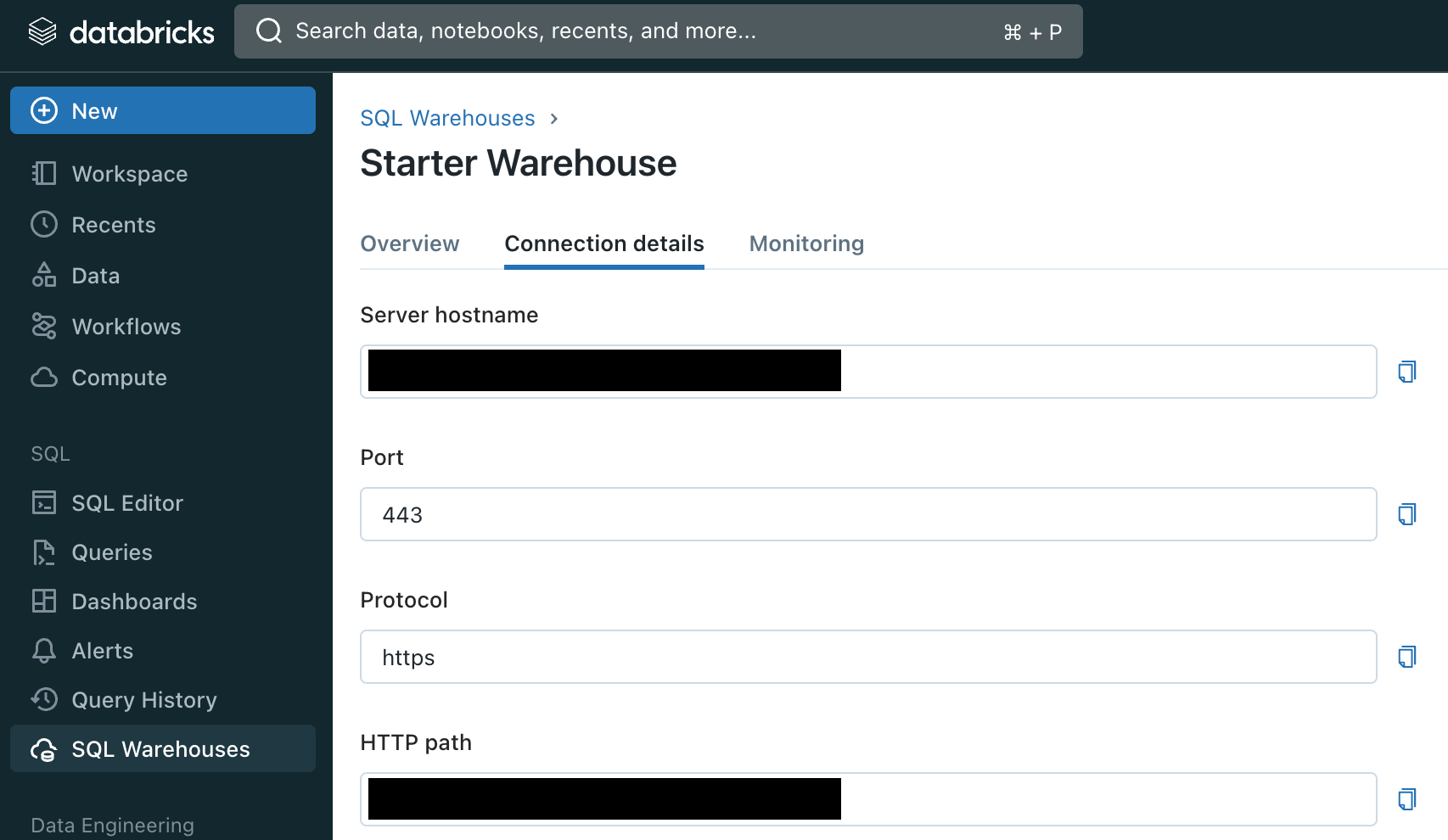
2. Choose an authentication method
GrowthBook supports two ways to authenticate against Databricks:- OAuth (machine-to-machine / service principal) — the recommended method. GrowthBook uses a Databricks service principal’s Client ID and OAuth secret to obtain short-lived access tokens automatically at query time.
- Personal Access Token (PAT) — the legacy method. Databricks now recommends OAuth over personal access tokens because OAuth provides stronger security.
Option A: OAuth (machine-to-machine)
OAuth M2M authenticates using a Databricks service principal. GrowthBook exchanges the service principal’s Client ID and OAuth secret for short-lived tokens (via theclient_credentials grant) and refreshes them automatically, so you never store a long-lived token.
- Create a Databricks service principal (or reuse an existing one). See the Databricks docs on managing service principals.
- Generate an OAuth secret for that service principal. Databricks shows the Client ID (the service principal’s application ID) and lets you generate a Secret. Copy both now — the secret is only shown once. See OAuth machine-to-machine (M2M) authentication.
- Grant the service principal permission to use your SQL Warehouse and access the data you want to query.
- In GrowthBook, you will enter the Client ID and OAuth Secret in step 3 below.
Option B: Personal Access Token
There are two kinds of access tokens that will work to connect GrowthBook to Databricks:- A personal access token for a user account
- A personal access token for a service principal