

How ramp schedules work
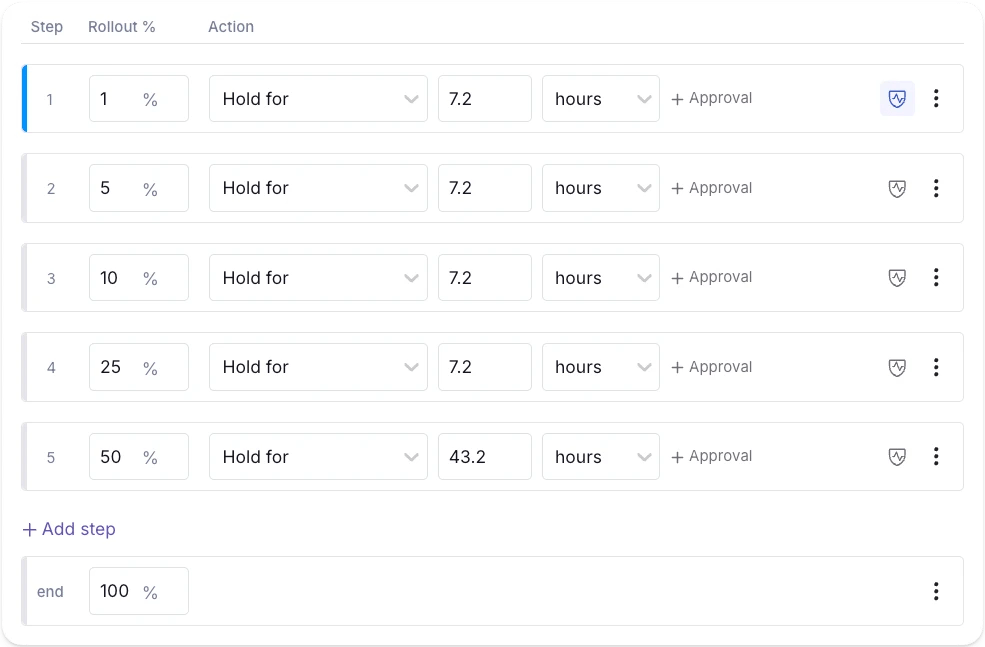
A Ramp Schedule attaches to a single Targeting rule (a rule that serves a value to matching users, with optional targeting conditions). It is a release plan on top of that rule, not a separate rule type. You add one from the rule editor by choosing Ramp-up as the release plan. The schedule drives the rule through an ordered list of steps. Each step only sets the fields you want to change; everything else carries over from the previous step. A step can change:- Rollout %: the percentage of matching users who get the rule’s value.
- Targeting: the condition, saved groups, and prerequisites.
- Environments: which environments the rule applies to.
- Value: the value the rule serves.
- Hold for: apply the step, then wait a set amount of time (for example, 12 hours) before advancing.
- Hold for approval: apply the step, then wait for a teammate to approve before advancing. You can also add + Approval to a timed step so it waits on both. Approval is always the final gate, so any time or sample-size conditions clear first.
- Hold for min. sample: wait until a set number of users have been exposed. This applies only to monitored steps.
previousStepIndex shows the gap — rampSchedule.actions.step.advanced, or rampSchedule.actions.completed when the fold finishes the ramp. Consumers mirroring ramp progress should diff currentStepIndex - previousStepIndex rather than counting events. Approval and monitored steps are never skipped by a catch-up — the schedule always stops at them.
The grid always ends with an end row, set to 100% by default. That is the state the rule lands in when the schedule finishes; open its menu to attach final rule changes, such as removing targeting.
Schedule timing
- Start: choose Immediately to begin as soon as the rule is published, or On date to delay activation. The rule stays disabled until the start date.
- Duration: the total length of the ramp. In Simple View you set it directly and GrowthBook spaces the steps to fit; in Advanced View it shows a computed summary of your steps, such as “~5d + monitored steps”.
- Disable on date: click + Disable on date to set an optional date that turns the rule off whether or not the ramp has finished. Use it for time-boxed rules.
Lock feature while running
Turn on Lock feature while running to block publishing other draft changes to the feature while the ramp is actively progressing. This keeps manual edits from competing with the schedule.The lock only applies while the ramp is running. It does not apply when the ramp is paused, completed, or rolled back, and it never blocks the changes the ramp engine makes as it advances. Pause the ramp to make immediate changes.
Sample by and hashing
Sample by sets the attribute GrowthBook hashes to assign users to the rollout, so the same user stays in the same bucket as the rollout grows. Expand Hashing & seed options to set a custom Seed or pick the Hashing algorithm version. These work the same as on a standard rollout rule.Ramp schedule vs. Safe Rollout
A Safe Rollout is a Ramp Schedule with guardrail monitoring turned on. Both use the same engine. The difference is whether you watch metrics as the ramp progresses.- Use a plain Ramp Schedule when you want a release plan that runs on its own: step the rollout up over time, broaden targeting in stages, gate jumps behind approval, or disable the rule on a set date.
- Use a monitored Ramp Schedule (a Safe Rollout) when you also want GrowthBook to watch guardrail metrics and automatically hold or roll back if the release harms them.
Adding a ramp schedule
1. Add a Targeting rule
When you add a rule to a feature, choose Targeting rule as the rule type.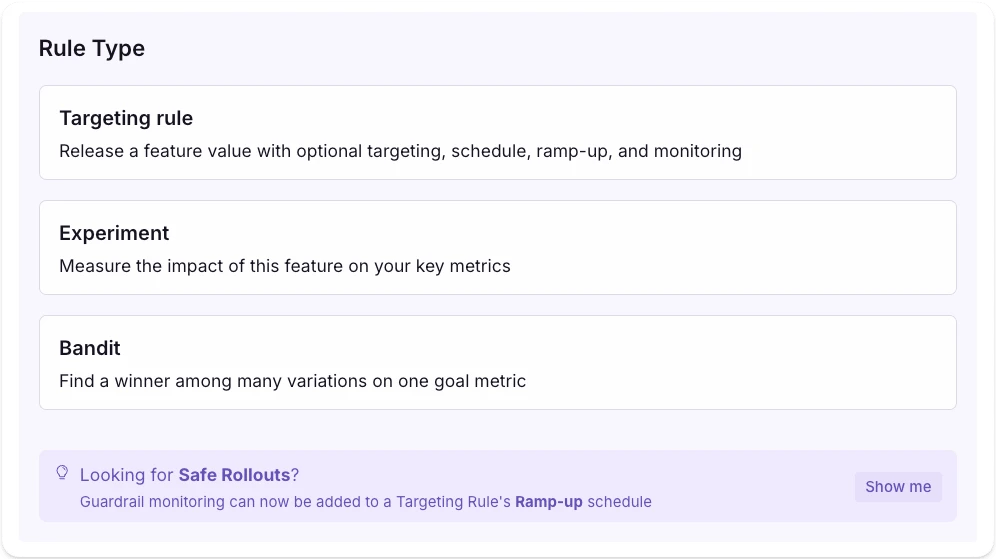
2. Choose the Ramp-up release plan
In the rule settings, set the release plan to Ramp-up (or Monitored Ramp-up to watch guardrail metrics). The ramp editor opens so you can define the steps.3. Configure the steps
The step editor opens in one of two modes:- Simple View: pick a total Duration and GrowthBook spreads a standard set of steps (1%, 5%, 10%, 25%, 50%, then 100%) across it. Good for a quick, standard ramp.
- Advanced View: edit the step grid directly. Each row sets a Rollout % and an Action, and you can add per-step approval, monitoring, or rule changes. Switch between modes with the Edit Ramp-up Steps and Simple View buttons.
4. Set the start and disable dates
Optionally set Start to On date to delay activation, and use + Disable on date to turn the rule off at a fixed time.5. Publish
Publish the revision to arm the schedule. A schedule configured inside a draft stays in thepending state until that draft is published.
Monitored steps and guardrails
Mark a step as monitored (the shield icon on the step) to run guardrail analysis while it is active. GrowthBook splits enrolled users 50/50 between the new value and the existing value and analyzes your guardrail metrics, using the same engine as a Safe Rollout. On a monitored step, the Rollout % is the share of users who get the new value, and an equal-sized control group gets the existing value. Rollout % is capped at 50% on monitored steps: at that point the new value and the control each reach half your users, so no one is left out.A monitored step at 50% is a full 50/50 split: half your users get the new value and half get the existing value. Set it to 25% to show the new value to 25% of users, with a 25% control.
- Data source and Assignment table: where traffic and metric data come from.
- Guardrail Metrics: GrowthBook automatically rolls back and disables the rule if any of these show a significant regression.
- Signal Metrics: GrowthBook pauses at the current step if any of these regress. You resume manually, or it resumes automatically when the metric recovers.
- Refresh results every: how often GrowthBook re-analyzes your metrics. Leave it blank to use the org default (6 hours).
Hold step pauses the ramp for review, Roll back rewinds the rule to its pre-ramp state and ends the schedule, and Warn only flags the issue without stopping the ramp. The no-traffic grace period defaults to 24 hours and is editable next to If no traffic. Guardrail regressions always roll back and disable the rule; that behavior is not configurable here.
Sticky bucketing is disabled on monitored steps, because the hash ranges shift as the rollout grows. Hold for min. sample applies only to monitored steps, since unmonitored steps have no analysis to evaluate.
Operating a running schedule
Once started, a schedule reports its status and progress on the feature’s rule.
From the UI or API you can start, pause, resume, manually advance, jump to a specific step, approve a gated step, roll back to the pre-ramp state, or restart a finished schedule. Every transition is recorded in the schedule’s event history.
Editing a rule under a running schedule
A schedule stores the rule’s pre-ramp state as its base state and re-applies it, plus every step so far, each time it advances. While the schedule isrunning, the rule cannot be edited: the rule editor locks the rollout percentage, targeting, and value, and a publish that changes the rule is refused with the schedule’s pause route. Pause the schedule first. A schedule with no steps (enable now, disable on a date) never locks its rule.
While it is paused (or ready, before it starts), publishing an edit to the rule reconciles it with the plan:
- A field the plan sets in a step or its end state, usually the rollout percentage (
coverage), is refused with the step named; change it in the plan instead. - Any other change to the rule’s targeting or value is written into the base state, so it applies immediately, survives the remaining steps once you resume, and is what a rollback restores.
- Some older schedules share one base state across a rule’s per-environment copies (for example
fr_1__devandfr_1__production). A change that would leave those copies different is refused, since the shared base state would apply it to all of them. Remove the ramp from the rule, publish the change, then attach a new schedule.
eject-target and DELETE leave the rule as it is right now, so a ramp can always be cleaned up.
Reverting the Feature Flag to a revision published before a schedule was attached removes that schedule from the rule, and deletes it once it controls no rules; you’re warned first. A running schedule still needs pausing before the revert, like any other change to its rule. A scheduled or auto-published revert fails instead of removing a schedule attached after its draft was created, so publish that one manually to confirm.
Templates
Use Save as template to store a schedule’s steps and end state as a Ramp Schedule Template and reuse them across features. Apply a template when you create a schedule to inherit its steps, then override any of them as needed.Managing via the API
The recommended way to attach a ramp schedule to a rule, or to change the plan of one that is already attached, is through a draft revision. The plan is then reviewed and published like any other rule change, and the scheduler carries it out step by step afterwards."startState": { "hashAttribute": "id" }; the request is refused otherwise. seed and hashVersion can be set there too and default to the rule id and version 2.
Once a schedule is live, operate it with the lifecycle actions under /api/v1/ramp-schedules/{id}/actions/… (start, pause, resume, advance, approve-step, rollback, complete, restart, eject-target) or delete it. These run or end the reviewed plan and are never review-gated. Editing the rule itself follows the base state rules: a publish is refused while the schedule is running (pause first) and for a field a step sets, and otherwise updates the schedule’s startActions. Look up the schedule id from the rule’s rampScheduleId field or with GET /api/v1/ramp-schedules?ruleId=….
The /api/v1/ramp-schedules endpoints can also create a schedule attached to a rule, add a target, or edit an attached schedule’s steps and dates directly, without a revision. Because that skips review, those operations are only available to credentials that may bypass approval whenever the organization requires review anywhere; other callers receive a 403 pointing at the revision endpoint above. See the API reference for the full set of endpoints.
What’s next
- Safe Rollouts: a Ramp Schedule with guardrail monitoring.
- Rules: choose the right rule type before adding a schedule.
- Publishing and approval flows: gate rule changes on reviewer approval.